History of Bellingham, WA: From Boomtowns to the Bay
If you spend enough time looking at homes for sale in Bellingham, you’ll start to notice something unique about the layout. You might find yourself asking why there seem to be two distinct downtown areas (one in the city center and one in Fairhaven), or why the architecture shifts so dramatically from Victorian brick to mid-century modern within just a few blocks.
The answer lies in the city’s nickname: the "City of Subdued Excitement." While it’s known today for its chill, outdoor-focused lifestyle, Bellingham’s history is anything but quiet. It is a story of rival settlements, gold rush chaos, industrial grit, and a massive consolidation that stitched four separate towns into the community we know today.
Let’s take a walk through the timeline to understand how this city came to be.
The City of Subdued Excitement: A Historical Overview
Bellingham isn’t just a college town or a jumping-off point for the San Juan Islands; it is a consolidation of ambitious, rival settlements that eventually realized they were stronger together.
The area has evolved through several distinct phases: starting as the ancestral homelands of Indigenous peoples, shifting into a chaotic resource outpost in 1852, merging into a single city in 1903, and finally transforming into the recreation and cultural hub we see now.
When you look at the different neighborhoods today, you are actually looking at the footprints of those original rival towns. Understanding this history helps explain why the city feels the way it does—layered, eclectic, and deeply connected to its geography.
Before the Settlers: The First Inhabitants
Long before the first maps were drawn or the first log cabin was built, this region was stewarded by the Coast Salish peoples, specifically the Lummi (Lhaq’temish) and Nooksack peoples. They have inhabited the coast and river valleys here since time immemorial, building a rich culture centered around the cedar forests and the abundant salmon runs.
The name "Whatcom"—which you’ll see on everything from the county name to the local museum—comes from a Nooksack word meaning "noisy water." This referred to the roaring falls at the mouth of Whatcom Creek. For thousands of years, the estuary below these falls served as a vital seasonal fishing encampment.
Today, the influence of the Lummi and Nooksack nations remains a vital part of the community’s identity, reminding us that the history of this land goes back much further than the Victorian era.
1852-1858: Mills, Mines, and the Gold Rush
The modern settlement of the area kicked off in 1852 when Henry Roeder and Russell Peabody arrived looking for water power to run a lumber mill. They found the perfect spot at the base of the falls on Whatcom Creek.
Industry followed quickly. In 1854, legend has it that travelers discovered coal in the roots of a fallen tree. This accidental find led to the opening of the Sehome Coal Mine, which brought infrastructure and workers to the area.
But things really exploded in 1858 with the Fraser River Gold Rush. Almost overnight, the quiet mill settlement turned into a staging ground for prospectors heading north into Canada. We aren't talking about a few hundred people; an estimated 75,000 transient prospectors flooded the area. For a brief moment, the bay was a chaotic tent city of dreams and desperation before the rush subsided as quickly as it began.
The Era of Four Towns: Distinct Personalities
One of the most confusing parts of local history for newcomers is understanding the "Four Towns." Before 1903, there was no single "Bellingham." Instead, there were four distinct settlements, each with its own personality and economic engine.
If you are thinking about living in Bellingham today, you can still feel the vibes of these original towns in the current neighborhoods:
Whatcom: Located in what is now Old Town and the northern part of downtown, this was the maritime hub and the county seat. It was the center of government and shipping.
Sehome: This was effectively a company town built on the hill, centered around the coal mine. Today, this area encompasses the upper part of downtown and the neighborhoods near Western Washington University.
Fairhaven: Perhaps the most famous of the four, Fairhaven was a speculative boomtown. Investors bet big that it would become the terminus for the Great Northern Railroad, competing directly with Seattle and Tacoma. This speculation left us with the gorgeous Victorian brick buildings that make the Fairhaven neighborhood guide so popular today.
Bellingham: Yes, there was a town actually called Bellingham. It was the quietest of the bunch, sandwiched between Sehome and Fairhaven.
From Rivals to One City: The 1903 Consolidation
By the turn of the 20th century, the rivalry between the towns had become expensive and inefficient. The Panic of 1893 had crushed the economy, and the railroad terminus had gone to Seattle, leaving Fairhaven’s dreams deflated.
Economic necessity drove the towns to the negotiating table. In late 1903, the residents voted to merge. On December 28, 1903, the consolidation became official.
So, why did they choose the name "Bellingham"? It was essentially a compromise. Since one of the towns was already named Bellingham (and the bay had been named Bellingham Bay by explorer George Vancouver), it was seen as the most neutral option. It allowed the rival citizens of Whatcom and Fairhaven to join forces without one side feeling like they had been conquered by the other.
Boom, Bust, and Social Complexity (1900s-1950s)
For the first half of the 1900s, the new city ran on the "Big Three" industries: Coal, Lumber, and Fishing. The salmon canneries along the waterfront were some of the most productive in the world.
However, this era also holds the city's darkest chapter. In 1907, the city was shaken by what is now known as the 1907 Bellingham Riots. A mob organized by the Asiatic Exclusion League attacked South Asian (mostly Sikh) mill workers, forcibly rounding them up and driving them out of town.
It is a somber piece of history that the community does not shy away from today. You will see monuments like the "Arch of Healing" located downtown, which was established to acknowledge this past and commit to a future of inclusivity.
As the century progressed, the economy began to shift. The coal mines closed, and the timber industry changed. The establishment of the New Whatcom Normal School—which eventually became Western Washington University—marked a pivot toward education and services, helping the city evolve beyond just resource extraction.
Adaptive Reuse: The Waterfront Renaissance
If you look at the waterfront today, you are seeing the latest chapter in Bellingham history: adaptive reuse. For decades, the waterfront was dominated by the massive Georgia-Pacific pulp and tissue mill, which cut the downtown off from the bay.
When the mill closed in the early 2000s, it left a huge industrial scar—but also a massive opportunity. The city is currently undergoing a multi-decade project to reclaim this land for public use, and it’s creating some of the most exciting waterfront living options in the region.
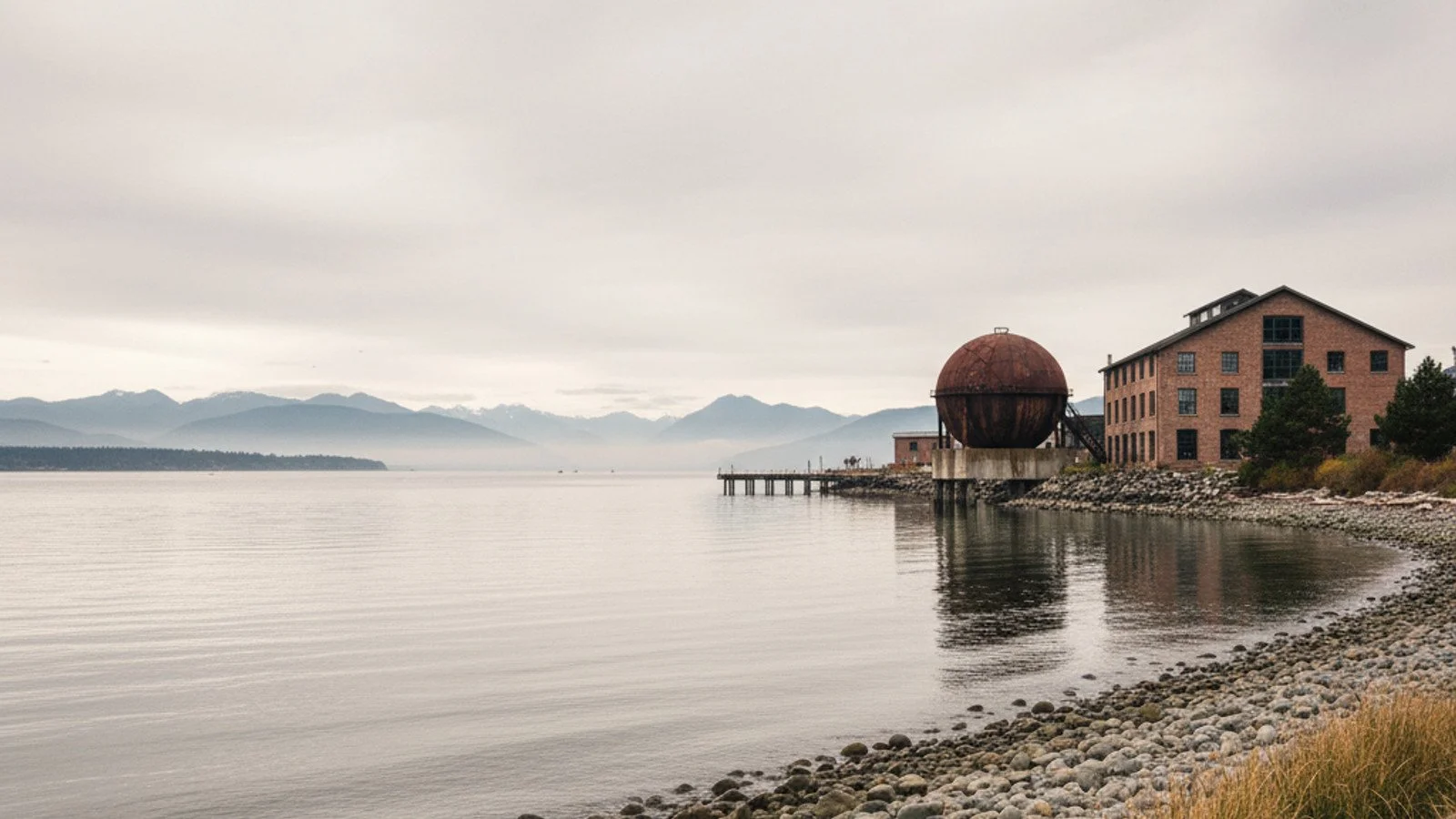
A prime example is the Granary Building. Built in 1928 as a cooperative for local egg and poultry farmers, it sat vacant for years. Recently renovated, it is now a trendy hub for shops and offices. Just outside sits the "Acid Ball," a giant metal sphere once used in the pulp processing system. Instead of scrapping it, the city coated it in reflective glass beads and turned it into a glowing landmark at Waypoint Park.
This blend of gritty industrial history and modern design is exactly what makes the local real estate market so interesting right now.
Where to Experience Bellingham's History Today
You don't need a time machine to see these layers of history; you just need to know where to walk. If you are visiting or scouting neighborhoods, here are a few spots that tell the story:
Historic Fairhaven District: Walk around 12th Street to see the Victorian brick architecture preserved from the railroad boom days. It’s a living movie set of the 1890s.
Old City Hall (Whatcom Museum): This striking red brick building with its clock tower was originally built for the city of New Whatcom. It is a Victorian landmark that dominates the skyline.
Pickett House: Located on Bancroft Street, this is Washington State’s oldest wooden building still standing on its original site.
Maritime Heritage Park: Located along Whatcom Creek, this park connects you to the salmon and fishing history that fueled the early economy.
Frequently Asked Questions
What were the four original towns of Bellingham?
The four original settlements were Whatcom, Sehome, Bellingham, and Fairhaven. They merged in 1903 to form the current city, though the distinct neighborhood vibes of Whatcom (Downtown) and Fairhaven remain today.
Why is it called the City of Subdued Excitement?
This nickname captures the local personality: laid-back, introverted, and content. It suggests that while residents love where they live, they prefer a quiet appreciation of nature and community over loud, flashy fanfare.
When was Bellingham, WA founded?
The first European settlers, Henry Roeder and Russell Peabody, arrived in 1852. However, the city as we know it—the legal entity of Bellingham—was officially incorporated on December 28, 1903, following the consolidation vote.
What is the history of the Granary Building?
The Granary Building was constructed in 1928 by the Whatcom County Dairymen’s Association. It served as a hub for the region's massive egg and poultry industry before being renovated around 2019 into a modern commercial center on the waterfront.
What happened during the 1907 Bellingham riots?
In September 1907, a mob of white workers attacked Sikh laborers who had come to work in the lumber mills, forcibly rounding them up and driving them out of the city. Today, the city acknowledges this event through memorials like the Arch of Healing to promote reconciliation and inclusivity.